Workplace Exposure Management ... beyond the detector
Building a connected response to Australia’s new workplace exposure limits
From 1 December 2026, Australian workplaces will transition to a new system of Workplace Exposure Limits for airborne contaminants. For underground mines, the challenge will extend beyond measuring hazardous particles: operations will need timely information, effective controls and reliable records that connect exposure conditions with people, equipment and locations.
Australia’s approach to airborne contaminants is entering a significant new phase.
From 1 December 2026, the Workplace Exposure Limits for airborne contaminants—or WEL list—will replace the existing Workplace Exposure Standards. Following implementation through Commonwealth, state and territory work health and safety laws, employers will need to ensure that no person at a workplace is exposed to an airborne contaminant above its applicable limit.
One of the most consequential changes for underground mining is the introduction of a national workplace exposure limit of 0.01 mg/m³ for diesel particulate matter, measured as elemental carbon. Safe Work Australia warns that exposure to diesel engine emissions can contribute to serious health effects, including lung disease and cancer.
Respirable crystalline silica also remains a critical concern. The current Australian exposure standard for RCS is 0.05 mg/m³ as an eight-hour time-weighted average. In June 2026, Safe Work Australia confirmed that RCS and eight other substances would retain their existing exposure levels when the WEL system commences, pending further work by ministers.
For mines, however, preparation cannot be reduced to checking two numbers in a compliance table. The greater operational challenge is understanding when hazardous conditions arise, who may be affected, what activity contributed to the event and whether the mine responded effectively.
That requires more than a standalone detector.
The limitations of retrospective monitoring
Traditional occupational hygiene programs remain essential, particularly where recognised sampling and laboratory analysis are required to assess regulatory compliance. However, conventional programs often provide only a retrospective view.
A worker may carry a sampling device throughout a shift, after which its filter is sent for laboratory analysis. By the time the result is returned, the task has been completed, the equipment has moved and the personnel involved may be working in another part of the mine.
The result can establish that exposure occurred, but it may not show precisely when the concentration increased, what was happening at that moment or which control measure failed to perform as expected.
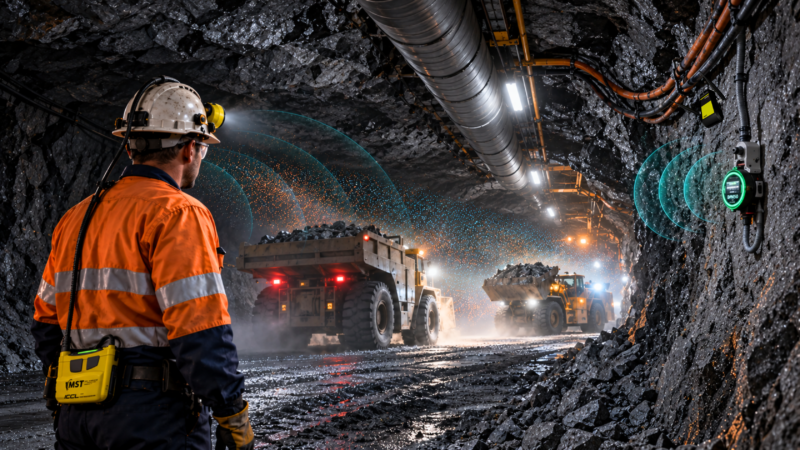
This information gap is particularly important underground. Airborne contaminant concentrations can change rapidly as diesel equipment enters an area, ventilation conditions alter, production activities begin or workers move through confined headings and other high-risk zones.
MST Global’s approach is designed to close that gap by bringing environmental monitoring, personnel and asset tracking, operational data, alerts and historical reporting together through its HELIX software platform.
The objective is not simply to collect more data. It is to turn exposure information into operational intelligence that can support decisions while an event is still developing.
Two forms of evidence from one monitoring process
A key element of the solution is the use of monitoring equipment that can generate two complementary forms of information.
The first is a continuous, near-real-time particulate reading. This gives operational and occupational hygiene teams immediate visibility of changing conditions, helping them identify peaks, investigate high-risk tasks and assess whether ventilation, dust suppression or other engineering controls are performing as intended.
The second, is from the device itself, a physical filter sample that the mine can retain and submitted for laboratory analysis when required. This provides a recognised pathway for confirmatory analysis and formal exposure assessment.
For diesel particulate matter, the sampling arrangement is designed around NIOSH Method 5040. This internationally recognised analytical method determines organic and elemental carbon collected on a filter, with elemental carbon used as the more selective indicator of workplace diesel particulate exposure. In coal mines, the method specifies appropriate size-selective sampling to help minimise interference from coal dust.
The combined monitoring approach is important because DPM is particulate matter, not a gas. A conventional gas detector may identify gases associated with combustion, such as carbon monoxide or nitrogen dioxide, but it does not directly measure the elemental-carbon particulate used to assess DPM exposure.
The selected DPM monitoring technology combines real-time optical measurement with filter-based sampling. It supports breathing-zone monitoring and can be configured for respirable, inhalable, thoracic, PM10 and PM2.5 fractions. Its flow-compensated pump maintains the required sampling flow, while the filter can be analysed separately when formal confirmation is required.
A similar two-part method can be applied to silica and respirable dust monitoring. Real-time particulate information identifies changing conditions during the shift, while a collected filter can support gravimetric and crystalline silica analysis using appropriate occupational hygiene methods.
Real-time readings therefore do not need to replace laboratory analysis. They add the immediacy that laboratory-only processes cannot provide.
Connecting exposure with location
A concentration reading is much more valuable when a mine can establish the context surrounding it.
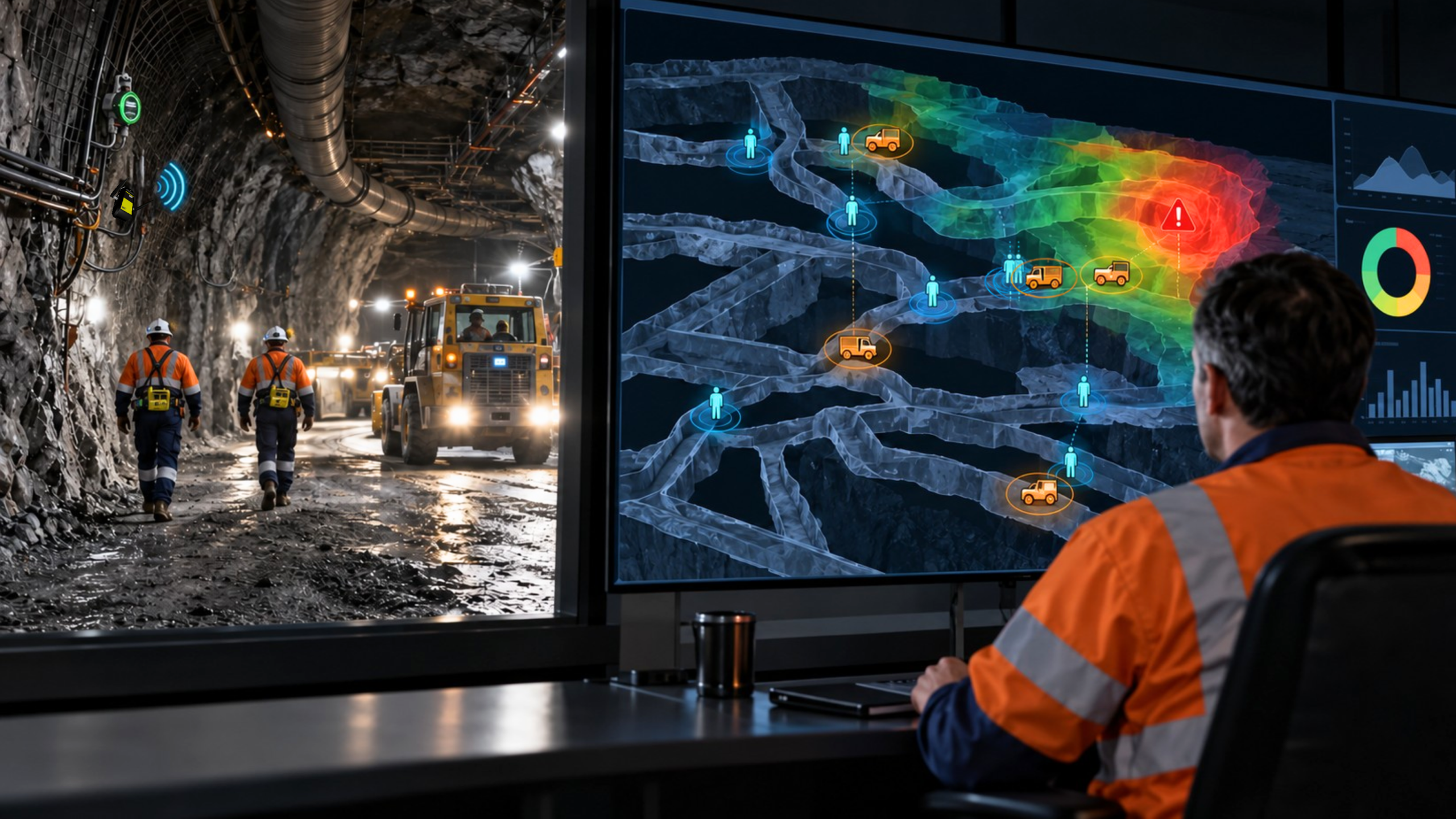
Through MST Global’s tracking technologies, HELIX can overlay environmental data with the location and movement of personnel, vehicles and other assets. Instead of seeing only that an elevated concentration occurred at 10:42 am, a mine can investigate:
- where the reading was recorded;
- which personnel were in or passed through the area;
- how long they remained within the affected zone;
- which mobile assets were present;
- what activities were underway;
- how conditions changed before and after the event; and
- whether alerts, ventilation changes or other responses were initiated.
This creates a clearer exposure narrative. A sudden DPM increase could, for example, be considered alongside the arrival of a diesel vehicle, changing equipment load or restricted ventilation. A respirable dust increase could be linked to drilling, cutting, crushing, loading or vehicle movement.
HELIX’s 2D and 3D mine visualisation can present this information geographically, allowing teams to identify exposure hotspots and compare them with personnel and asset movements. MST’s platform already supports real-time location visibility, configurable dashboards and the integration of tracking, environmental and operational information.
This is the difference between knowing that a hazard existed and understanding who or what may have been affected by it.
From visibility to intelligent control
Monitoring and tracking form the first part of the feedback loop. HELIX Intelligent Control enables the mine to use that information to initiate a response.
Sites can establish configurable rules based on their risk assessments, operating procedures and advice from competent occupational hygiene professionals. As monitored conditions approach a nominated threshold, HELIX can generate visual or audible warnings, notify responsible personnel and display the event through operational dashboards.
Where the necessary field infrastructure and controls are integrated, the system can support further responses such as increasing ventilation, activating localised controls, restricting access to an affected zone or escalating an alarm when conditions persist.
MST’s Intelligent Control architecture connects IoT sensors and field equipment with HELIX using protocols including Modbus. The same architecture can support applications such as ventilation control, pumps, traffic systems and event-triggered alarms, enabling environmental information to become an input into site automation rather than remaining isolated in a detector or spreadsheet.
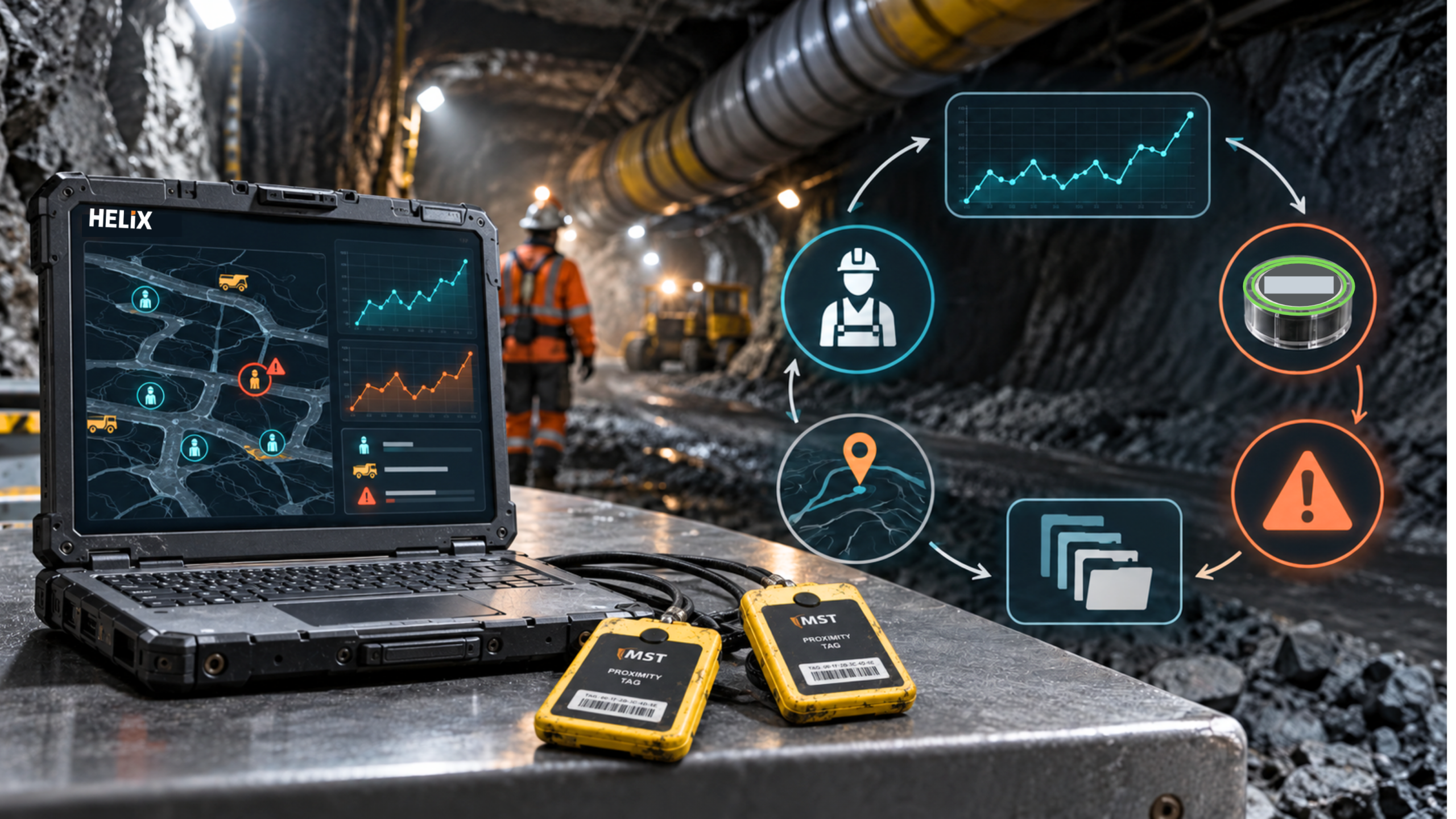
The resulting loop is continuous:
- Environmental instruments monitor conditions.
- Tracking establishes the location of personnel and assets.
- HELIX combines and visualises both data streams.
- Configured rules generate alerts or initiate an operational response.
- The event, response and subsequent conditions are recorded for investigation and reporting.
This does not remove the need for engineering controls, competent occupational hygiene advice or formal compliance monitoring. Safe Work Australia emphasises that risks must first be eliminated where reasonably practicable and otherwise minimised as far as reasonably practicable. Monitoring should verify and strengthen those controls—not substitute for them.
More than DPM and Silica
The architecture can also bring together a wider range of environmental information, subject to the sensors and sampling equipment selected for each mine.
Potential measurements include:
- real-time aerosol and dust concentration;
- respirable, inhalable and thoracic particulate fractions;
- PM1, PM2.5, PM4, PM5, PM10 and total suspended particulate, where supported;
- respirable crystalline silica trend data with filter collection for confirmatory analysis;
- diesel particulate matter and elemental-carbon-related trend data;
- temperature;
- relative humidity;
- barometric pressure;
- wet-bulb temperature or wet-bulb globe temperature when a compatible heat-stress sensor is installed; and
- gases such as oxygen, carbon monoxide, carbon dioxide, methane, nitrogen dioxide, hydrogen sulphide and sulphur dioxide when suitable third-party sensors are integrated.
It is important to distinguish what your device measures to determine whether you need a range of sensors. eg if it’s a particulate instrument you may need a broader sensor network. Wet-bulb conditions and gases, for example, require their own compatible sensors; MST’s DPM solution utilises a selected verified monitor that includes diesel particulate indicators, gas channels, and ambient-condition measurements into one monitor
HELIX provides the common environment into which the data can be sourced, displayed and evaluated.
Creating a long-term exposure record
The WEL transition also places greater attention on the quality and accessibility of exposure records.
HELIX can retain environmental readings, personnel and asset movements, alarm histories, responses and trend information according to the mine’s configured retention and governance policies. This makes it possible to examine patterns across shifts, work areas or extended operating periods rather than treating each sample as an isolated result.
Over time, these records can help mines identify recurring hotspots, compare conditions before and after control changes, prioritise ventilation improvements and demonstrate how exposure risks have been managed.
They can also provide a stronger foundation for audits and incident investigations. Instead of reconstructing an event from paper records and separate systems, authorised teams can review a connected timeline showing the environmental condition, the people and equipment present, the alarms generated and the actions recorded.
Preparing before the deadline
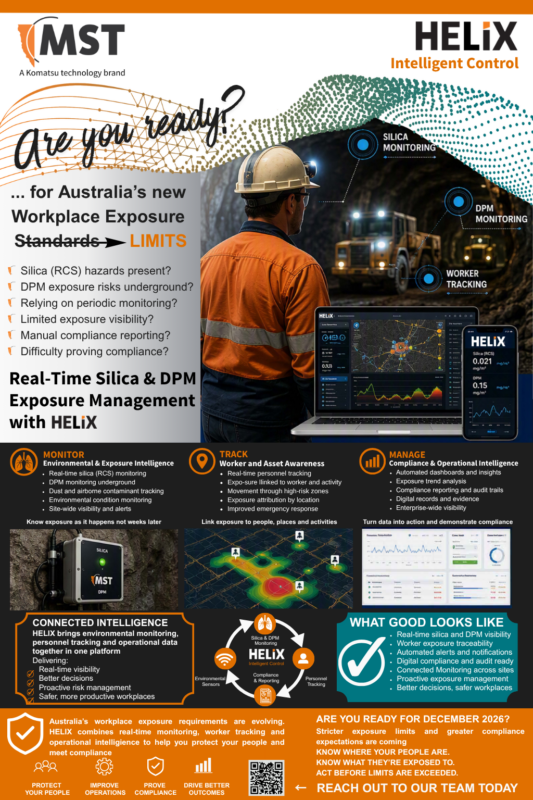
The transition date may be 1 December 2026, but an effective exposure-management system cannot be designed, installed and validated overnight.
Mines need time to identify their airborne hazards, confirm applicable limits, establish baseline conditions, select suitable instruments, integrate tracking and operational data, configure alarm rules and test how personnel respond.
The strongest outcome will not come from installing another detector and waiting for it to alarm. It will come from building a connected system capable of answering the questions that matter: Where are our people? What are they being exposed to? What is contributing to the exposure? What action should be taken—and can we demonstrate that it occurred?
By combining real-time monitoring and reporting, personnel and asset tracking, intelligent control and long-term reporting, MST Global’s HELIX ecosystem moves exposure management beyond detection.
It gives mines the ability to see changing conditions sooner, understand their operational context and act before a reading becomes an incident.
Download our flyer: Workplace Exposure Solution →
Fill in the form below to reach out to our team of experts to discuss how we can best support your compliance ...
Share This